General Dentistry
Teeth cleanings and exams in Scottsdale
An hour or so, twice a year, that prevents most of the dentistry you would rather not have.
Book a ConsultationTeeth Cleanings and Exams at Glisten
Calculus does not care how well you brush.
Plaque that sits on a tooth for a day or two mineralizes into calculus, and calculus bonds to enamel tightly enough that no toothbrush or floss removes it. Once it forms, professional instruments are the only way off, which is why even excellent brushers still need cleanings.
The exam half of the visit is the quiet value. Decay between teeth, early gum disease, cracks, and failing old work are all cheapest when caught before symptoms. A cleaning appointment is an early-detection visit with a polish attached.
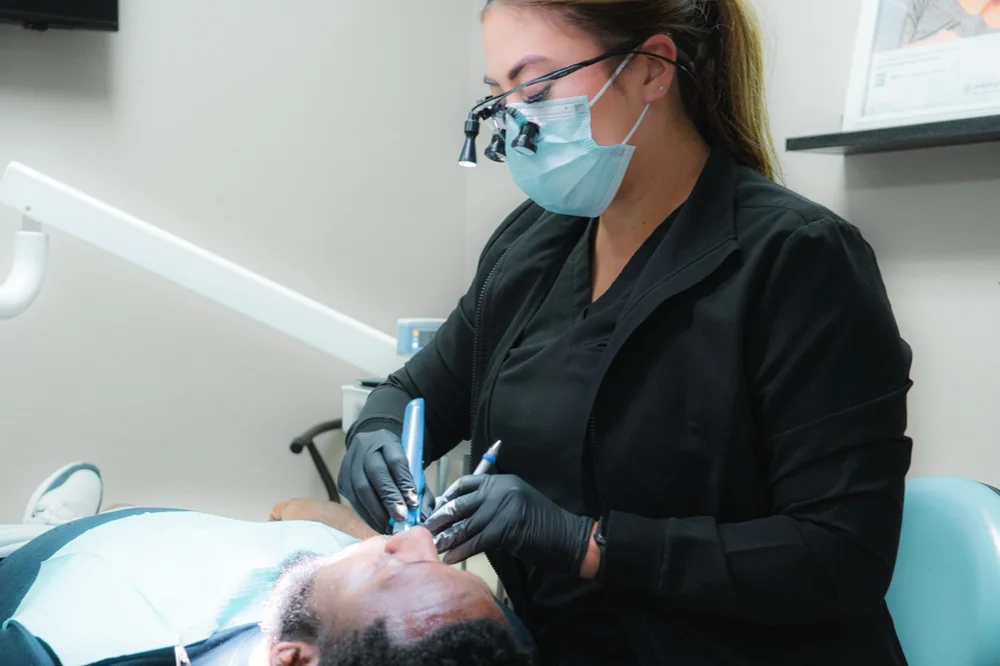
Why patients come in
- It has been more than six months
- Gums that bleed when you brush or floss
- Coffee, tea, or wine stain building up
- A baseline before any cosmetic or implant work
What to expect
What a cleaning visit actually includes.
-
01
History and screening
The visit starts with what changed: new medications, health changes, and a blood pressure check, followed by a screening of the tongue, cheeks, palate, and neck. Medications that dry the mouth change your decay risk, and the soft-tissue screen is how oral cancers get caught early.
-
02
Measurements before anything is scraped
The gums are measured around every tooth and the numbers recorded, so your gum health is tracked as data over the years rather than as an impression. Those numbers, plus X-rays when due, decide whether today is a routine cleaning or something more.
-
03
Scaling and polishing
Ultrasonic and hand instruments remove the calculus above and just below the gumline, then polishing clears surface stain and leaves the enamel smooth, which slows how fast new plaque sticks. This is the part you feel, and for healthy gums it is comfortable.
-
04
The exam and the plan
Dr. Dawood examines the teeth, bite, and any X-rays, checks existing fillings and crowns for early failure, and tells you plainly what needs attention, what gets watched, and what needs nothing. You leave with your numbers and the reasoning.
Candidacy
What your cleaning interval should be.
A good fit when
- Healthy gums and no disease history: the standard six-month cycle
- You want a baseline set before veneers, whitening, or implants
- You are due for X-rays and want them taken for a reason, not a habit
- You want your gum numbers tracked over time, not guessed at
Worth a conversation first when
- A history of treated gum disease, which usually means a three to four month cycle
- Bleeding that has persisted for weeks, which wants a diagnosis, not just a polish
- Certain medical conditions or medications that change how cleanings are planned
Your interval is set by your measurements and history, not by a wall calendar or an insurance allowance. If six months is right, we say six months. If your gums need you more often for a while, you will see exactly why in your own numbers.
What can go wrong.
For healthy gums a cleaning is comfortable. For inflamed gums it can be tender and there can be bleeding, which is diagnostic information rather than a reason to avoid the visit. Inflamed gums settle within a couple of weeks of consistent home care after the calculus is gone.
The bigger risk is the skipped cleaning. Six months of accumulated calculus is a longer, less comfortable appointment. A few skipped years is how a routine visit quietly becomes deep cleaning territory, and deep cleaning territory is how teeth get loose in middle age.
Living with it.
Between visits, the work is yours and it is short: brush twice daily with fluoride toothpaste, clean between the teeth once a day with floss, brushes, or a water flosser, whichever you will actually use. Spit after brushing rather than rinsing, so the fluoride stays on the enamel.
Frequency of sugar and acid matters more than quantity. Sipping a sweet drink over two hours bathes the teeth far longer than finishing it in two minutes. Small habit changes here move your exam findings more than any product on a shelf.
Worth knowing
The parts of a cleaning worth understanding.
What the measurements mean
When the gums are measured, a small probe reads the depth of the space between gum and tooth at several points around every tooth. Shallow readings are health. Deeper readings mean the gum has detached and disease is active below the line where your brush reaches. Bleeding during the reading adds information about how active the inflammation is.
Those numbers are why the cleaning-versus-deep-cleaning question is not a sales pitch. They are written in your chart, they are compared visit to visit, and they are yours to see. Ask for yours. A practice that measures and shows you is a practice whose recommendations you can audit.
X-rays: how often and why
X-rays exist to find what the eye cannot: decay starting between teeth, bone levels around roots, infections at root tips, and what is happening under old work. For most healthy adults the small between-teeth images are due every year or two, with wider imaging on a longer cycle or when a specific question needs it.
The word that matters is due. Imaging should follow your risk and your history, not a reflex. At Glisten Dental Scottsdale each set of X-rays has a clinical reason attached, and modern digital sensors keep the exposure low. If you are ever unsure why an image is being taken, ask. The answer should be one sentence long.
The decision
Routine cleaning or deep cleaning?
Routine cleaning
Right when gum measurements are healthy: shallow pockets, no bone loss on X-rays. Cleaning happens above and just below the gumline and is preventive care in the truest sense.
Deep cleaning
Right when measured pocket depths and bone levels say gum disease is active. It is a different procedure for a different diagnosis, done with numbing, and the recommendation is based on numbers, not preference.
Improve home care and recheck
Right for borderline gums with inflammation but no bone loss. Sometimes the right prescription is two focused months of flossing and a recheck before anyone instruments below the gumline.
Not sure whether you need a routine clean or deeper treatment? The measurements decide that, not a guess, and you will see them.
Book a ConsultationQuestions
Teeth Cleanings and Exams FAQ
Will my cleaning hurt?
With healthy gums, no. With inflamed gums there can be tenderness and some bleeding around the sore areas, and numbing gel or local anesthesia is available if a spot is genuinely sensitive. Discomfort that lingers is a signal worth investigating, not something to push through.
Do I need X-rays at every visit?
No. Between-teeth images for healthy adults are typically taken every year or two, more often for higher-risk patients, and wider imaging on a longer cycle or when a specific question needs answering. Each set at Glisten Dental Scottsdale has a documented reason.
Will a cleaning whiten my teeth?
Polishing removes surface stain from coffee, tea, and wine, so teeth often look brighter after a cleaning. It does not change the underlying enamel color. For that, professional whitening is the tool, and freshly cleaned enamel is the best starting point for it.
Can I skip cleanings if I brush and floss well?
No, because home care cannot remove calculus. Once plaque hardens, which happens within a couple of days, only professional instruments take it off. Excellent brushers accumulate less, but they still accumulate, and skipped years reliably turn a routine visit into a bigger one.
What is the difference between a cleaning and a deep cleaning?
A routine cleaning is preventive work on healthy gums, above and just below the gumline. A deep cleaning is treatment for diagnosed gum disease, instrumenting further below the gumline with numbing, usually across two visits. The decision between them comes from your measured pocket depths and bone levels, not from preference.
How often should I really come in?
Six months is the right rhythm for most healthy adults. A history of gum disease usually means every three to four months, because the bacteria that drive it re-establish faster. Your interval is set from your own measurements and adjusted as your mouth changes.
Ready to talk it through?
Request a consultation at the Scottsdale studio.
Book a ConsultationHelpful reading: General dentistry · Financing · No insurance?
Also at Glisten Dental Scottsdale: General Dentistry · Tooth Fillings · Teeth Whitening · Dental Crowns